


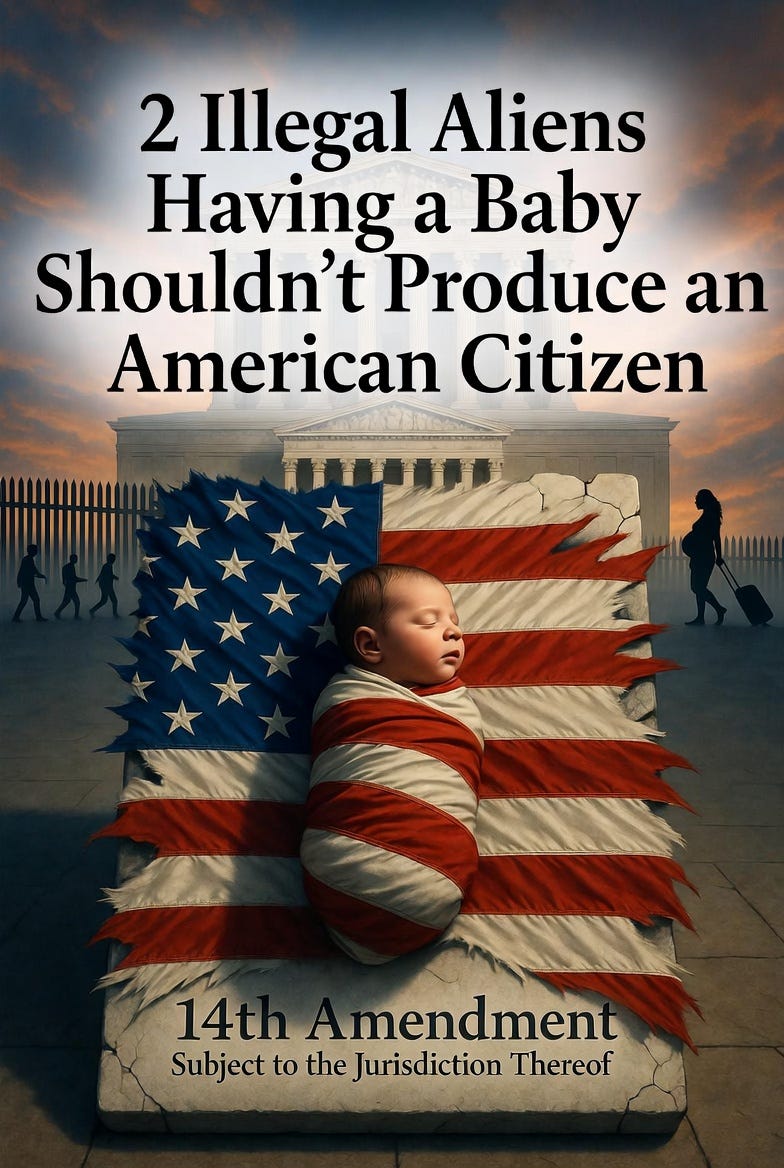
Anchor Babies, Birth Tourism, and the National Security Loophole the Supreme Court Can Finally Close
The 14th Amendment was never intended to grant automatic U.S. citizenship to the children of people who enter America illegally. Yet a widespread misinterpretation of the Citizenship Clause has turned birth on U.S. soil into an automatic pathway to American citizenship — creating “anchor babies” that incentivize illegal immigration and expose national security vulnerabilities through birth tourism. With the Supreme Court hearing oral arguments on April 1, 2026, in the landmark case Trump v. Barbara, the justices now have the opportunity to correct this constitutional error and restore the original meaning of the 14th Amendment.
The Constitutional Reality: “Subject to the Jurisdiction Thereof”
The Citizenship Clause of the 14th Amendment states: “All persons born or naturalized in the United States, and subject to the jurisdiction thereof, are citizens of the United States...”Ratified in 1868 to protect freed slaves after the Civil War, the clause was never meant as a blanket grant of citizenship.
Its drafters explicitly excluded children of diplomats, invading armies, and those not owing full allegiance to the United States. Senator Jacob Howard, a principal sponsor, made clear on the Senate floor that the provision would not cover “foreigners, aliens” or children of foreign ministers. Illegal aliens — by definition present in violation of federal law — are not fully “subject to the jurisdiction” of the United States. They remain subject to deportation and owe primary allegiance to their home country.
The same logic applies to temporary visitors on tourist, student, or other non-immigrant visas who lack permanent domicile. The Supreme Court’s 1898 ruling in United States v. Wong Kim Ark does not contradict this. That decision granted citizenship to a child of legal permanent residents domiciled in the U.S. It never addressed children of illegal entrants or short-term visitors. Extending it to cover “anchor babies” stretches the holding far beyond its scope.
President Trump’s January 2025 Executive Order (No. 14,160) correctly interprets the clause by directing agencies not to recognize automatic citizenship for children born after February 20, 2025, when the mother is unlawfully present or on temporary status and the father is neither a U.S. citizen nor lawful permanent resident. Lower courts blocked it, but the Supreme Court — with arguments now concluded — is poised to rule by late June or early July 2026.
The Perils of “Anchor Babies” and Illegal Immigration Incentives
Granting automatic citizenship to children of two illegal aliens creates powerful perverse incentives:
The newborn U.S. citizen gains access to welfare benefits, public education, and healthcare.
At age 21, that citizen can sponsor their illegal-alien parents for legal status — effectively rewarding lawbreaking.
This “anchor baby” dynamic burdens American taxpayers with billions in annual costs while encouraging further illegal crossings.
Children born via birth tourism gain full U.S. citizenship rights — including access to sensitive jobs, security clearances, voting, and the ability to sponsor family — without any background checks, loyalty screening, or residency requirements.
Raised overseas with minimal ties to America, they can be groomed by foreign governments (particularly adversarial ones like China) for espionage, influence operations, or technology theft.
The practice enables fraud, money laundering, and potential recruitment by hostile intelligence services.
Unlike naturalized citizens, these “birthright” Americans bypass vetting entirely.
Hundreds of thousands of such births occur each year to unauthorized immigrants, distorting immigration enforcement and undermining sovereignty. Birth Tourism: A National Security Loophole Even more dangerous is birth tourism — the deliberate practice where wealthy foreigners enter on tourist visas (B-1/B-2), give birth in the U.S., and return home with a new American citizen child. Maternity hotels in states like California cater to clients from China, Russia, and other nations, charging tens of thousands for “birth packages.” Estimates of annual birth tourism births range from 20,000–36,000 in recent years.
The State Department has previously highlighted these vulnerabilities, tightening visa rules for pregnant travelers. Lawmakers continue to warn that birth tourism from high-risk countries creates long-term threats to U.S. security. Other major democracies — including Canada, Australia, and the United Kingdom — have already reformed or eliminated unrestricted birthright citizenship to prevent similar abuses. America should not remain an outlier that invites exploitation.
Time for the Supreme Court to Act
Critics claim ending automatic citizenship for children of illegal aliens and temporary visitors is “unconstitutional” or radical. In reality, it restores the 14th Amendment’s text, history, and original public meaning. The Supreme Court in Trump v. Barbara has a historic chance to clarify that birth on U.S. soil alone does not confer citizenship when parents lack full jurisdictional allegiance.
This ruling would apply prospectively, without stripping existing citizens of their status. Congress could also act to codify this understanding, but a clear Supreme Court decision would settle the constitutional question decisively.
Why the Supreme Court Is Unlikely to End Birthright Citizenship Outright
Despite the strong constitutional arguments for limiting automatic citizenship, the Supreme Court is not likely to deliver a sweeping ruling that ends birthright citizenship for all children born on U.S. soil. Oral arguments on April 1, 2026, revealed broad skepticism among the justices — including several conservative members — toward President Trump’s executive order. Many questioned whether the president has unilateral authority to reinterpret the 14th Amendment’s Citizenship Clause so dramatically, especially given 125 years of precedent interpreting Wong Kim Ark more expansively.
A majority appeared inclined to strike down or sharply narrow the order, preserving the long-standing practice of near-universal birthright citizenship while potentially leaving room for narrower distinctions. This outcome would reflect institutional caution: the Court often hesitates to upend deeply entrenched understandings of constitutional text without clearer congressional action or overwhelming historical consensus.
Two illegal aliens having a baby in the United States should not automatically produce an American citizen. Sovereignty, fiscal responsibility, and national security all demand an end to this loophole. The Constitution permits — and prudence requires — the Supreme Court to get it right.
there is no such thing as an illegal alien. there are unauthorized immigrants or undocumented persons. language matters. hopefully the supreme court will restore the original intent of the 14th amendment. however there are some issues with trump's idea of who should vote.